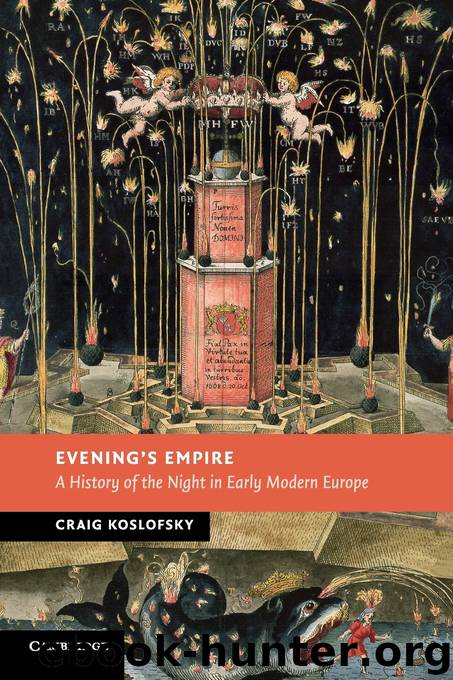
Evening's Empire (New Studies in European History) by Craig Koslofsky
Author:Craig Koslofsky [Koslofsky, Craig]
Language: eng
Format: epub
Publisher: Cambridge University Press
Published: 2015-06-19T16:00:00+00:00
Chapter Eight Darkness and Enlightenment
How did Europeans understand darkness and the night, real and symbolic, as the rhythms of daily time shifted? This chapter examines several key controversies of the early Enlightenment in the context of daily experiences and popular beliefs associated with the night and its shadows. The imprint of nocturnalization on these controversies reveals the unevenness of nocturnalization and of the universal claims made by the New Philosophy. Claims to dispel darkness, literal or figurative, lead us to darkness relocated or recreated elsewhere. The tension between the universalism of light and the selective use of the night refigures our understanding of the origins of the Enlightenment and the special place of its early or radical phase.
The study of nocturnalization in the preceding chapters has revealed two contrasting but ultimately complementary responses to darkness and the night in the seventeenth century. Two sets of discourses and practices arose: one which sought to dispel darkness and transform the night, and another focused on creating and manipulating darkness, whether in devotion or spectacle. These two faces of nocturnalization left their imprint on the form and content of the early Enlightenment. In the first set of discourses and practices, the new street lighting was often described as vanquishing the darkness by transforming night into day: “The night will be lit up as bright as day, in every street,” as a 1667 report on the new street lighting of Paris exclaimed.1 This sense of triumph over darkness is reflected on an intellectual level by Spinoza, for example, who defined darkness as a nonentity in a 1663 treatise, arguing that “We imagine nonentities positively, as beings … we imagine as if they were beings all those modes which the mind uses for negating, such as blindness, extremity, or … darkness, etc.”2 In his Essay Concerning Human Understanding Locke made clear that the association of the night with frightening supernatural beings was entirely contingent: “The ideas of goblins and sprites have really no more to do with darkness than light,” he explained. The problem was a false association created by young women:
yet let but a foolish maid inculcate these often on the mind of a child, and raise them there together, possibly he shall never be able to separate them again so long as he lives, but darkness shall ever afterwards bring with it those frightful ideas, and they shall be so joined, that he can no more bear the one than the other.3
Download
This site does not store any files on its server. We only index and link to content provided by other sites. Please contact the content providers to delete copyright contents if any and email us, we'll remove relevant links or contents immediately.
| Africa | Americas |
| Arctic & Antarctica | Asia |
| Australia & Oceania | Europe |
| Middle East | Russia |
| United States | World |
| Ancient Civilizations | Military |
| Historical Study & Educational Resources |
Room 212 by Kate Stewart(5184)
The Crown by Robert Lacey(4862)
Endurance: Shackleton's Incredible Voyage by Alfred Lansing(4845)
The Iron Duke by The Iron Duke(4405)
The Rape of Nanking by Iris Chang(4256)
Joan of Arc by Mary Gordon(4156)
Say Nothing by Patrick Radden Keefe(4044)
Killing England by Bill O'Reilly(4042)
I'll Give You the Sun by Jandy Nelson(3496)
Shadow of Night by Deborah Harkness(3412)
Hitler's Monsters by Eric Kurlander(3385)
Mary, Queen of Scots, and the Murder of Lord Darnley by Alison Weir(3240)
Blood and Sand by Alex Von Tunzelmann(3240)
Eleanor & Park by Rainbow Rowell(3238)
Darkest Hour by Anthony McCarten(3161)
Margaret Thatcher: The Autobiography by Thatcher Margaret(3113)
Book of Life by Deborah Harkness(2984)
Red Famine: Stalin's War on Ukraine by Anne Applebaum(2970)
The One Memory of Flora Banks by Emily Barr(2898)
